Tool Use
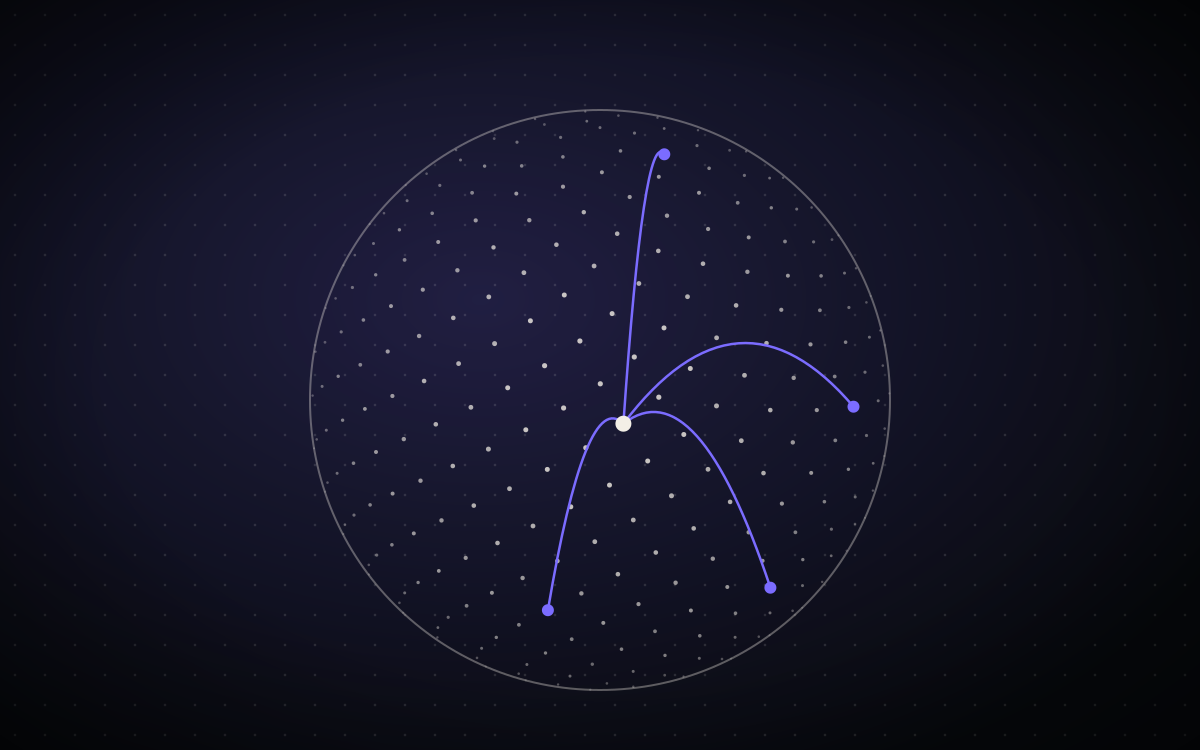
LLMs learning to call external tools, APIs, or functions to extend capabilities beyond text generation (calculators, search, code execution).
Your route here
18 stops · basics first
- Natural Language Processing ✓ understood
The field of AI that lets computers read, interpret, translate and generate human language, from spam filters and search to chatbots.
- Token ✓ understood
The basic unit of text that a language model processes, typically representing a word, subword, or character. Tokens are the fundamental building blocks for LLM input and output.
- Tokenization ✓ understood
Splitting text into tokens, usually subword pieces, and mapping each to an integer ID so a language model can process it.
- Language Modeling ✓ understood
Learning probability distributions over sequences of words to predict what comes next.
- Dataset ✓ understood
A collection of data examples used for training, validating, or testing machine learning models.
- Training ✓ understood
The process of fitting a model to data by repeatedly measuring how wrong its outputs are and adjusting its parameters to reduce that error.
- Machine Learning ✓ understood
Building systems that learn patterns from data instead of following hand-written rules, getting better at a task as they see more examples.
- Unsupervised Learning ✓ understood
Learning from unlabeled data to discover hidden patterns, structures, or relationships without explicit target outputs.
- Self-Supervised Learning ✓ understood
Learning representations from unlabeled data by creating supervised tasks from the data itself (masked prediction, contrastive learning).
- Pre-training ✓ understood
Training a model on a large dataset (often self-supervised) before fine-tuning on specific tasks, enabling transfer learning.
- Feature ✓ understood
A single measurable property of an example, such as a house's floor area or how many links an email contains, used as an input to a model.
- Neural Network ✓ understood
A computational model inspired by biological neural networks, consisting of interconnected nodes (neurons) organized in layers that process information through weighted connections.
- Deep Learning ✓ understood
A subset of machine learning that uses neural networks with multiple layers (deep neural networks) to learn hierarchical representations of data.
- Representation Learning ✓ understood
Learning useful features or representations of data automatically, rather than hand-crafting them.
- Embedding ✓ understood
A list of numbers (a vector) that represents a word, sentence, image or other item, learned so that similar items end up close together.
- Attention Mechanism ✓ understood
A technique that lets a neural network weigh every part of its input when producing each output, focusing on the parts most relevant at that step.
- Transformer ✓ understood
A neural network architecture, introduced in 2017, built from stacked self-attention and feed-forward layers; the basis of nearly every modern large language model.
- Large Language Model ✓ understood
A neural network, almost always a transformer, trained on vast amounts of text to predict the next token, which lets it write, answer, summarize and follow instructions.
- Tool Use · you are here ✓ understood
Picture it
- 01 User asks a question "What's 17% of 2,340?"
- 02 Model emits a tool call Structured name + arguments, e.g. JSON
- 03 App runs the tool Calculator, search, code, API
- 04 Result returns to model Added to the context as a tool result
- 05 Model answers Grounded in the tool's output
Where it sits
Explore nearby
In the research
All papers →11 papers that build on Tool Use ; showing 5, canon first.
 Canon · 2022 ReAct: Synergizing Reasoning and Acting in Language Models The think–act–observe loop in ReAct is the skeleton of nearly every LLM agent and coding harness today.
  Frontier · Dec 2025 · 671 citations DeepSeek-V3.2: Pushing the Frontier of Open Large Language Models It shows an open model competing with the best closed ones on reasoning while getting cheaper to run.
  Frontier · Feb 2026 · 174 citations SkillsBench: Benchmarking How Well Agent Skills Work Across Diverse Tasks It is the first careful evidence that skills work, and that smaller models with good skills can match bigger ones.
  Frontier · Sep 2025 · 139 citations SimpleTIR: End-to-End Reinforcement Learning for Multi-Turn Tool-Integrated Reasoning A one-idea fix that makes multi-turn tool-using RL trainable.
  Frontier · Aug 2025 · 101 citations WebWatcher: Breaking New Frontier of Vision-Language Deep Research Agent Deep-research agents have been text-only; this extends them to the visual web.