Landmark 20 stops to get here

AI Agent

A system where a large language model decides its own next steps in a loop: calling tools, reading the results, and continuing until the task is done.

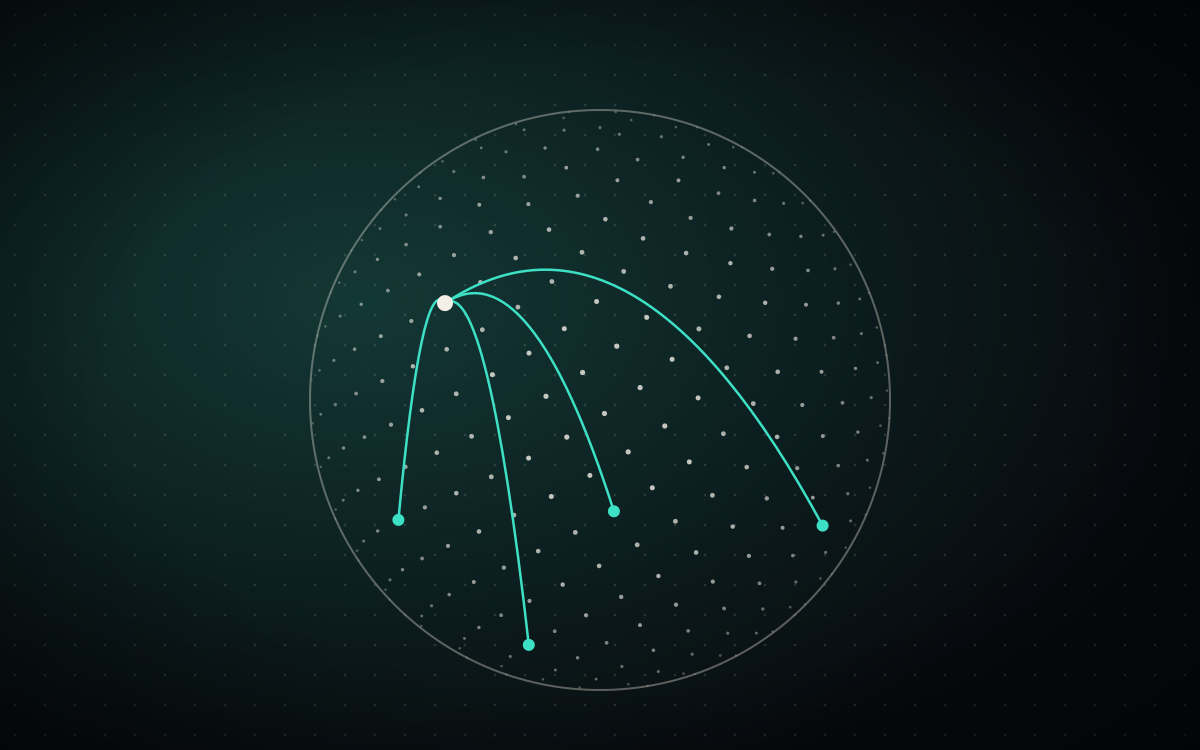
Your route here

20 stops · basics first
  1. Natural Language Processing ✓ understood

    The field of AI that lets computers read, interpret, translate and generate human language, from spam filters and search to chatbots.

  2. Token ✓ understood

    The basic unit of text that a language model processes, typically representing a word, subword, or character. Tokens are the fundamental building blocks for LLM input and output.

  3. Tokenization ✓ understood

    Splitting text into tokens, usually subword pieces, and mapping each to an integer ID so a language model can process it.

  4. Language Modeling ✓ understood

    Learning probability distributions over sequences of words to predict what comes next.

  5. Dataset ✓ understood

    A collection of data examples used for training, validating, or testing machine learning models.

  6. Training ✓ understood

    The process of fitting a model to data by repeatedly measuring how wrong its outputs are and adjusting its parameters to reduce that error.

  7. Machine Learning ✓ understood

    Building systems that learn patterns from data instead of following hand-written rules, getting better at a task as they see more examples.

  8. Unsupervised Learning ✓ understood

    Learning from unlabeled data to discover hidden patterns, structures, or relationships without explicit target outputs.

  9. Self-Supervised Learning ✓ understood

    Learning representations from unlabeled data by creating supervised tasks from the data itself (masked prediction, contrastive learning).

  10. Pre-training ✓ understood

    Training a model on a large dataset (often self-supervised) before fine-tuning on specific tasks, enabling transfer learning.

  11. Feature ✓ understood

    A single measurable property of an example, such as a house's floor area or how many links an email contains, used as an input to a model.

  12. Neural Network ✓ understood

    A computational model inspired by biological neural networks, consisting of interconnected nodes (neurons) organized in layers that process information through weighted connections.

  13. Deep Learning ✓ understood

    A subset of machine learning that uses neural networks with multiple layers (deep neural networks) to learn hierarchical representations of data.

  14. Representation Learning ✓ understood

    Learning useful features or representations of data automatically, rather than hand-crafting them.

  15. Embedding ✓ understood

    A list of numbers (a vector) that represents a word, sentence, image or other item, learned so that similar items end up close together.

  16. Attention Mechanism ✓ understood

    A technique that lets a neural network weigh every part of its input when producing each output, focusing on the parts most relevant at that step.

  17. Transformer ✓ understood

    A neural network architecture, introduced in 2017, built from stacked self-attention and feed-forward layers; the basis of nearly every modern large language model.

  18. Large Language Model ✓ understood

    A neural network, almost always a transformer, trained on vast amounts of text to predict the next token, which lets it write, answer, summarize and follow instructions.

  19. Context Window ✓ understood

    The maximum number of tokens an LLM can process at once, including both input prompt and generated output. Also called context length.

  20. Tool Use ✓ understood

    LLMs learning to call external tools, APIs, or functions to extend capabilities beyond text generation (calculators, search, code execution).

  21. AI Agent · you are here ✓ understood

Picture it

Read contextTask, instructions, historyDecide next stepThe LLM chooses an actionCall a toolSearch, run code, edit a fileObserve the resultFed back into the contextUntil done or stopped
  1. 01 Read context Task, instructions, history
  2. 02 Decide next step The LLM chooses an action
  3. 03 Call a tool Search, run code, edit a file
  4. 04 Observe the result Fed back into the context

↺ back to 01 · Until done or stopped

Each turn, the tool's result goes back into the context, so the model's next decision is grounded in what actually happened.

An AI agent is a large language model put in a loop with tools. Instead of answering once, the model decides what to do next (read a file, search the web, run a test), looks at the result, and decides again, until the task is finished or it hits a stopping condition.

Not to be confused with Agent in reinforcement learning: the learner that acts in an environment to earn reward. The ideas are cousins, but an AI agent’s decisions come from a language model prompted with the task and its history, not from a policy trained on rewards.

Agent or workflow?

Anthropic draws a useful line. In a workflow, code fixes the sequence of steps and the model fills each one in. In an agent, the model directs its own process and chooses which tools to use and when. Agents trade predictability for flexibility, which pays off on open-ended tasks where the steps can’t be known in advance.

What makes an agent work

  • Tools (tool use): the actions the model can take, each described well enough that it knows when to call them.
  • Ground truth at every step: tool results, errors and test output tell the agent whether it’s on track. Without that feedback, mistakes compound and hallucinations go unchecked.
  • Context management: every result lands in the context window, which fills up. Long tasks need summarizing, or delegating to subagents with fresh context; The Duel shows why that matters for cost.
  • Stopping conditions and checkpoints: a maximum number of steps, and pauses for a human to review before anything risky.

The 2022 ReAct paper showed an early version of the pattern: interleaving the model’s reasoning with actions, so each thought could react to real observations.

Coding agents such as Claude Code and opencode are AI agents specialized for software. The Agentic Coding Harnesses course takes apart how several of them are built.

Where it sits

AI Agent

Leads to

Nothing yet: a destination in its own right.

Explore nearby

In the research

All papers →

32 papers that build on AI Agent ; showing 5, canon first.

Canon · 2022 ReAct: Synergizing Reasoning and Acting in Language Models The think–act–observe loop in ReAct is the skeleton of nearly every LLM agent and coding harness today. Frontier · Aug 2025 · 409 citations GLM-4.5: Agentic, Reasoning, and Coding (ARC) Foundation Models It is one of the strongest open models for agents and coding at a fraction of rivals’ active size. Frontier · Feb 2026 · 313 citations Kimi K2.5: Visual Agentic Intelligence Parallel sub-agents trained into the model itself point to where agent orchestration is heading. Frontier · Feb 2026 · 295 citations GLM-5: from Vibe Coding to Agentic Engineering It is a marker of open models moving from “vibe coding” to real agentic engineering. Frontier · Oct 2025 · 236 citations Agentic Context Engineering: Evolving Contexts for Self-Improving Language Models It gives a principled shape to “context engineering”, the craft behind most agent harnesses.

Sources

  1. Anthropic, "Building effective agents" . Erik Schluntz and Barry Zhang, December 2024
  2. Yao et al., "ReAct: Synergizing Reasoning and Acting in Language Models" . 2022